Movement Library

Movements with structure.

Ultimate Lift is built on curated training data, not a flat exercise list. The Library already contains 900+ movement definitions and 3,500+ variation paths, making it one of the most authoritative sources of anatomical movement, muscle, and joint data available online.

900+ movement definitions
3,500+ movement variations
150+ muscles
30+ joints
40 evaluated sources

In the app

The Library is visible in the app, not hidden in a spreadsheet.

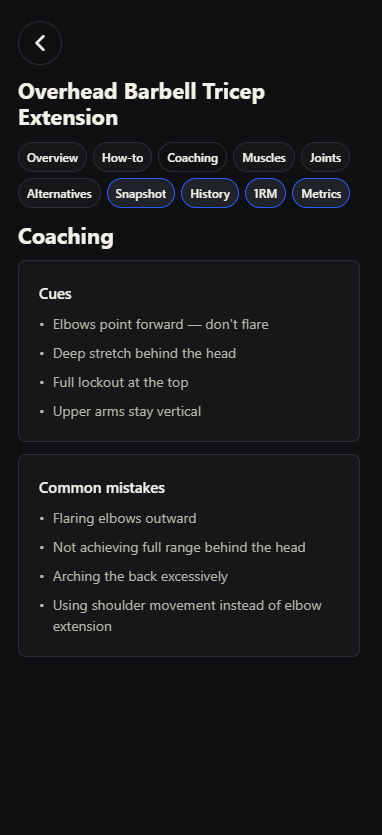
Movement entries expose practical reference data for lifters and coaches: overview, how-to guidance, coaching cues, muscles, joints, variations, history, 1RM context, and metrics. Separate muscle and joint databases make the anatomical layer searchable.
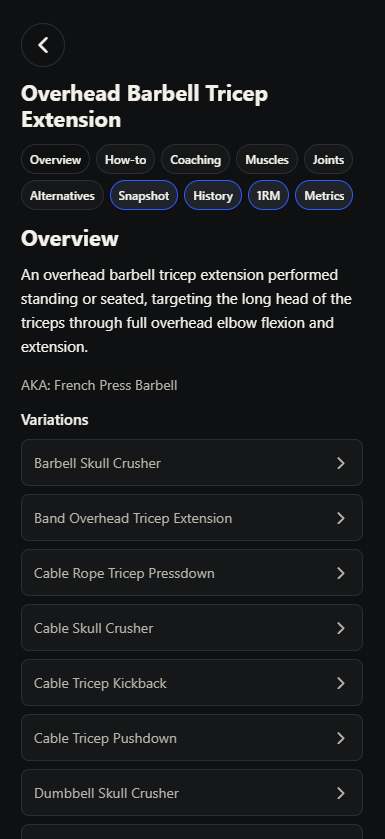
Ultimate Lift movement Library screen showing an overhead barbell tricep extension overview with variations and reference tabs
Movement overview
Ultimate Lift movement Library screen showing coaching information for a movement
Coaching detail
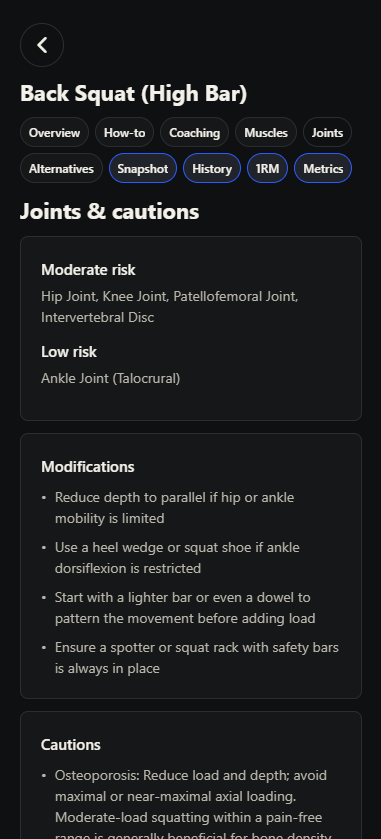
Ultimate Lift movement Library screen showing joint data for a movement
Movement joint load
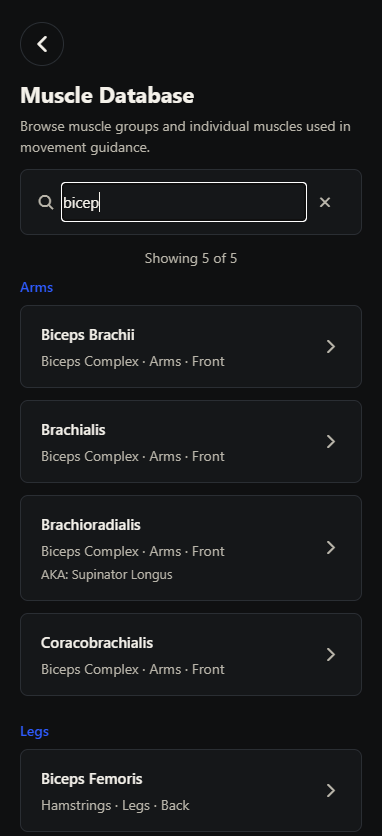
Ultimate Lift muscle database screen filtered to biceps-related muscles
Muscle database
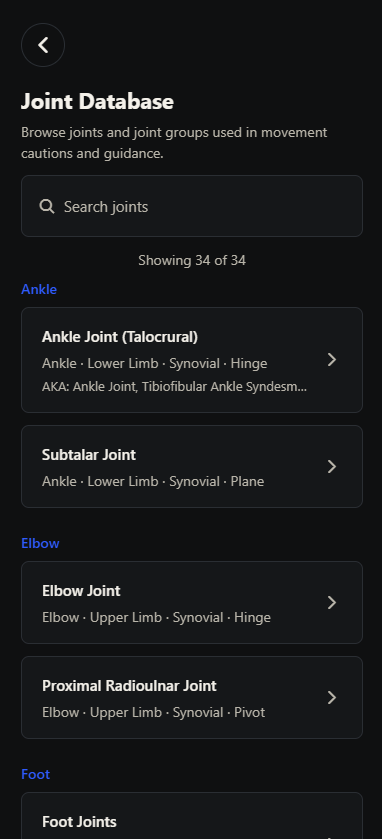
Ultimate Lift joint database screen listing joints and joint groups
Joint database

Data depth

Not exercise names. Movement objects.

Each movement can carry taxonomy, programming rules, anatomy, joint load, execution guidance, constraints, and substitution logic. The sample pages expose a small slice of the same structure used to power coaching, logging, and programme decisions.

Aggregate rows Across squat, deadlift, and bench press
Taxonomy fields 30
Muscle rows 39
Joint rows 15
Substitution links 30
Name variants 17
Per movement Visible data rows by sample lift

Back Squat (Low Bar)

37
Taxonomy 10
Muscles 13
Joints 6
Substitutions 3
Aliases 5

Conventional Deadlift

50
Taxonomy 10
Muscles 17
Joints 5
Substitutions 12
Aliases 6

Barbell Flat Bench Press

44
Taxonomy 10
Muscles 9
Joints 4
Substitutions 15
Aliases 6
Classification

Movement identity

  • Pattern, type, category, family, super-family
  • Plane, laterality, body position, weight bearing
  • Technical demand, balance demand, impact, popularity
  • Grip, spotting, equipment tier, setup requirements
Programming

Programming context

  • Intensity models: %1RM, RPE, RIR, absolute kg
  • Recommended tempo, time-based flags, variation tags
  • Control credit, control signals, movement tags
  • Recovery cost and programme coverage hints
Anatomy

Muscle mapping

  • Primary and secondary muscle group tiers
  • Individual muscle engagement by region
  • Stabiliser and support roles where relevant
  • Training-relevant grouping for programme balance
Joint load

Risk and mechanism

  • Joint group severity by movement
  • Individual joint mechanisms
  • Load mechanisms such as shear, compression, extension
  • Constraint data for pain, injury, and equipment changes
Execution

Coaching content

  • Setup text and phase-by-phase execution model
  • Breathing pattern and recommended tempo
  • Coaching cues and common mistakes
  • Modifications, regressions, and progressions
Alternatives

Substitution graph

  • Alternatives, regressions, progressions, and variations
  • Reason tags explaining why a swap is useful
  • Full movement names rather than raw slugs
  • Name variants and aliases for discoverability

Sample movements

Reference entries from the current Library.

These examples show how a familiar lift becomes a structured movement object with anatomy, programming, execution, and substitution data.

Squat / Compound

Back Squat (Low Bar)

The low-bar back squat positions the barbell across the rear deltoids and mid-trapezius, creating a more forward-leaning torso angle than the high-bar variant. This shifts emphasis toward the posterior chain — glutes and hamstrings — and typically allows 5-10% more weight than high-bar due to the shorter moment arm at the hip.

13 Muscles
7 Muscle groups
6 Joint groups
6 Joints
Intensity
%1RM, RPE, RIR, Absolute kg
Open movement
Hinge / Compound

Conventional Deadlift

The conventional deadlift pulls a loaded barbell from the floor to hip height using a hip-width stance and shoulder-width grip, demanding powerful hip and knee extension with a rigid trunk. It is the root of the deadlift family and the heaviest posterior chain movement most lifters will perform.

17 Muscles
7 Muscle groups
4 Joint groups
5 Joints
Intensity
%1RM, RPE, RIR, Absolute kg
Open movement
Push / Compound

Barbell Flat Bench Press

The flat barbell bench press is the foundational horizontal pressing movement, driving chest, anterior deltoid, and triceps development through a full range of motion while lying supine on a flat bench. It is the root of the bench press family and the standard upper-body pressing test.

9 Muscles
5 Muscle groups
3 Joint groups
4 Joints
Intensity
%1RM, RPE, RIR, Absolute kg
Open movement